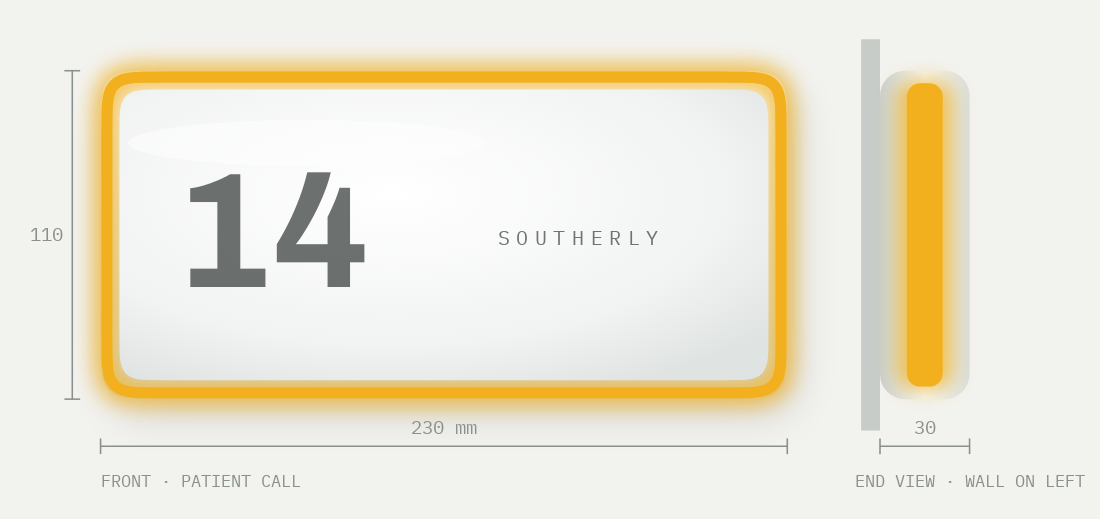
Two calls at once
The band is split into 24 individually controlled zones. When an emergency and a patient call are active in the same room, the band shows both, one at each end, so nobody has to walk to the room to find out which call is waiting. Each call priority has its own colour and pattern, set to the site's standard.
The room number, built in
Every lens is laser-etched with its room number and lit from behind, so the number glows at night and reads clearly by day. Lenses are made from the site's room list and checked against the room when the light is commissioned, so the wrong number can't end up over the wrong door.
Knows who's in the room
A Bluetooth direction-finding antenna behind the lens tracks staff badges along the corridor and through the doorway. When a nurse walks into the room, the light shows staff present and clears it when they leave. Presence is shown, never used on its own to cancel a call.
Built for the bus
ODL-01 is the room's node on the ward bus. It takes 48 V and RS-485 over Cat6 from the Ward Hub, powers the room's call points over a protected 24 V feed, and passes the bus on to the next room. The light and the bus run on their own controller, separate from the radio, so a radio fault can't blank the light.
Specifications
| Size | 230 × 110 × 30 mm, wall-mounted above the door frame |
|---|---|
| Light | 24-zone RGBW band around the edge, backlit laser-etched room number, day/night dimming |
| Staff location | Bluetooth direction finding (AoA), 4-element antenna array |
| Bus | RS-485 ward bus on Cat6, RJ45 in/out, up to 4 rooms per Ward Hub segment |
| Power | 48 V from the Ward Hub; protected 24 V feed to the room's call points |
| Supervision | LED and feed faults reported to the gateway |
| Status | In development |