What it does
- 8 relay outputs — latched, momentary or timed pulse — for over-door and reassurance lights, sirens, door releases and controller resets.
- 8 supervised inputs for dry contacts: duress buttons, controller fault relays, mains-OK, battery-low, door contacts, isolation switches. Each input raises a call type — Duress, Emergency, Assist, Call, Presence, Fault or Isolation — with its own routing.
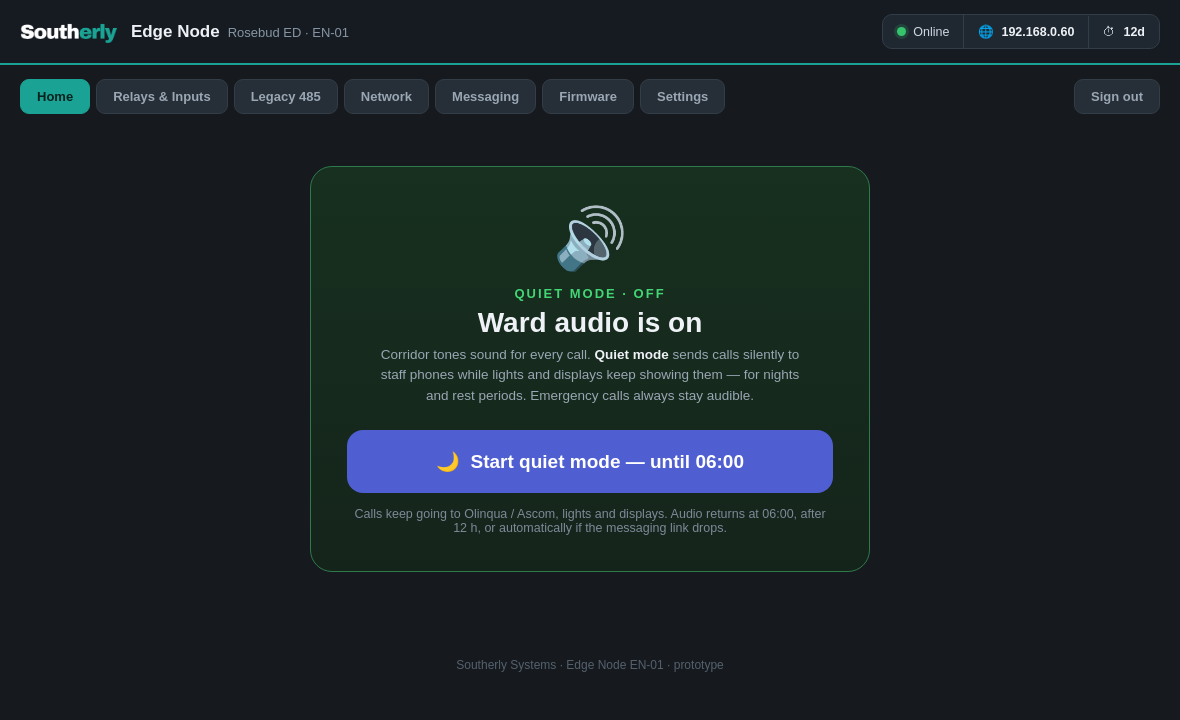
- Quiet Mode (Silent Hospital) — during quiet hours, routine call tones move from the corridor to staff phones; lights, displays and messaging stay on, emergency calls stay audible, and audio restores automatically if the silent path can't be proven. How Quiet Mode works →
- Clinical messaging — input and isolation events sent to Olinqua or Ascom over TAP with heartbeat supervision.
- Legacy 485 — reads, dumps and programs legacy display drivers and input modules from the site map, over the network.
- Isolation indicator — recolours a ward display or drives a light when a ward is isolated.
- Secure by default — HTTPS on the LAN only, password login, signed firmware, OTA update from a file or a server, automatic rollback.
Expansion Available now
A node drives a PoE I/O expansion module (XM-02): eight more relays and eight more supervised inputs, placed wherever the lights and contacts are, on one PoE cable. Expansion inputs are real call inputs — each has its own call type, contact sense and label and routes to relays, speaker, messaging and the ward display exactly like an onboard input. The link is Ethernet first with an RS-485 backup: the node fails over in under two seconds and back, raises an event on every path change, and the expander holds a defined relay state if it loses the node entirely. A duress button on an expander input reaches the ward board in well under a second. One expander per node in the current firmware; the design scales to eight (72 outputs / 72 inputs).
Network
Reports the switch and port it is plugged into (CDP/LLDP), the PoE budget granted and the VLAN — the facts an IT team asks for before a device goes on a hospital network. Works on an isolated LAN with no internet; takes time from a local NTP source and broadcasts it to legacy displays.
A ward display, built in
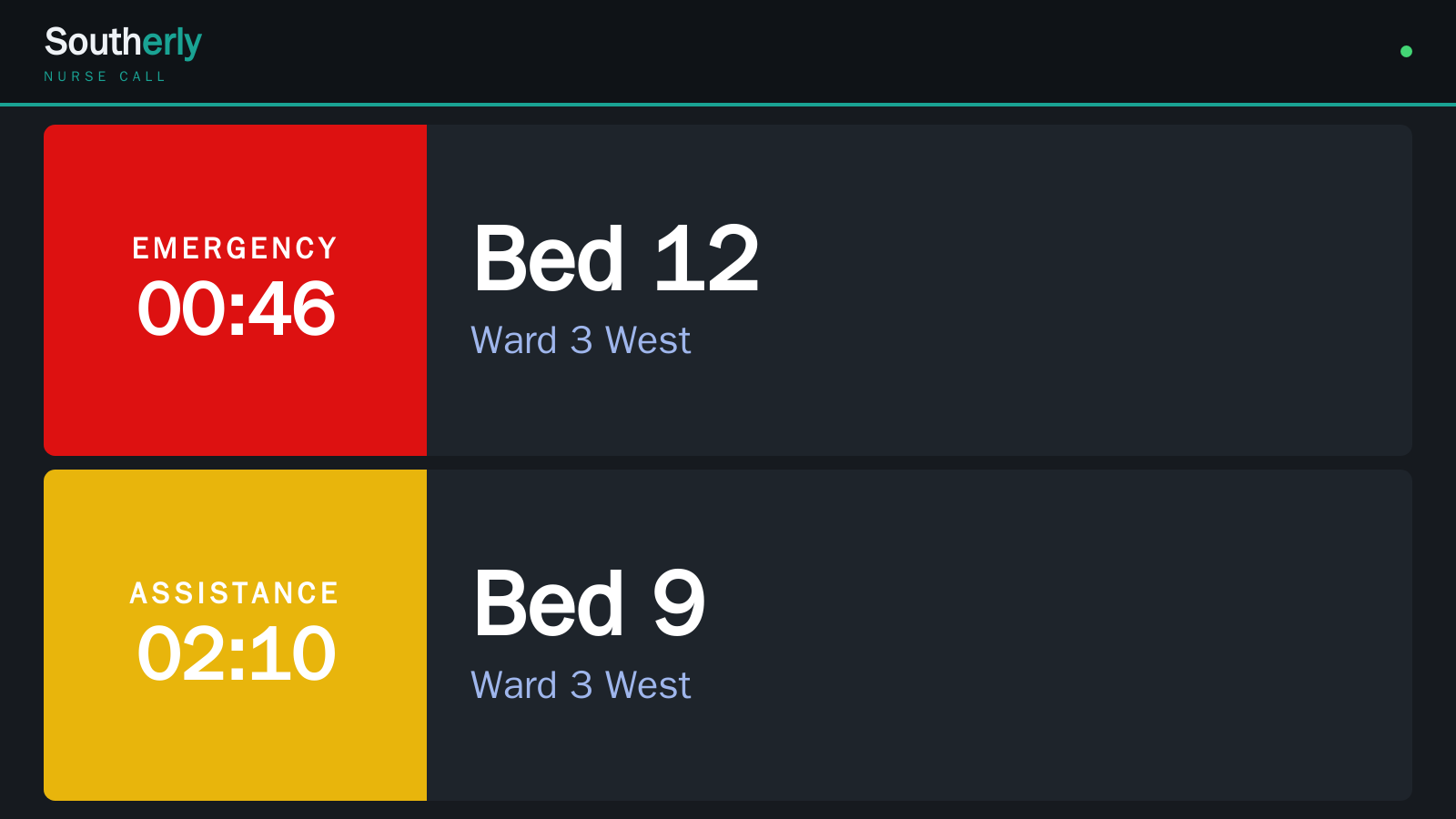
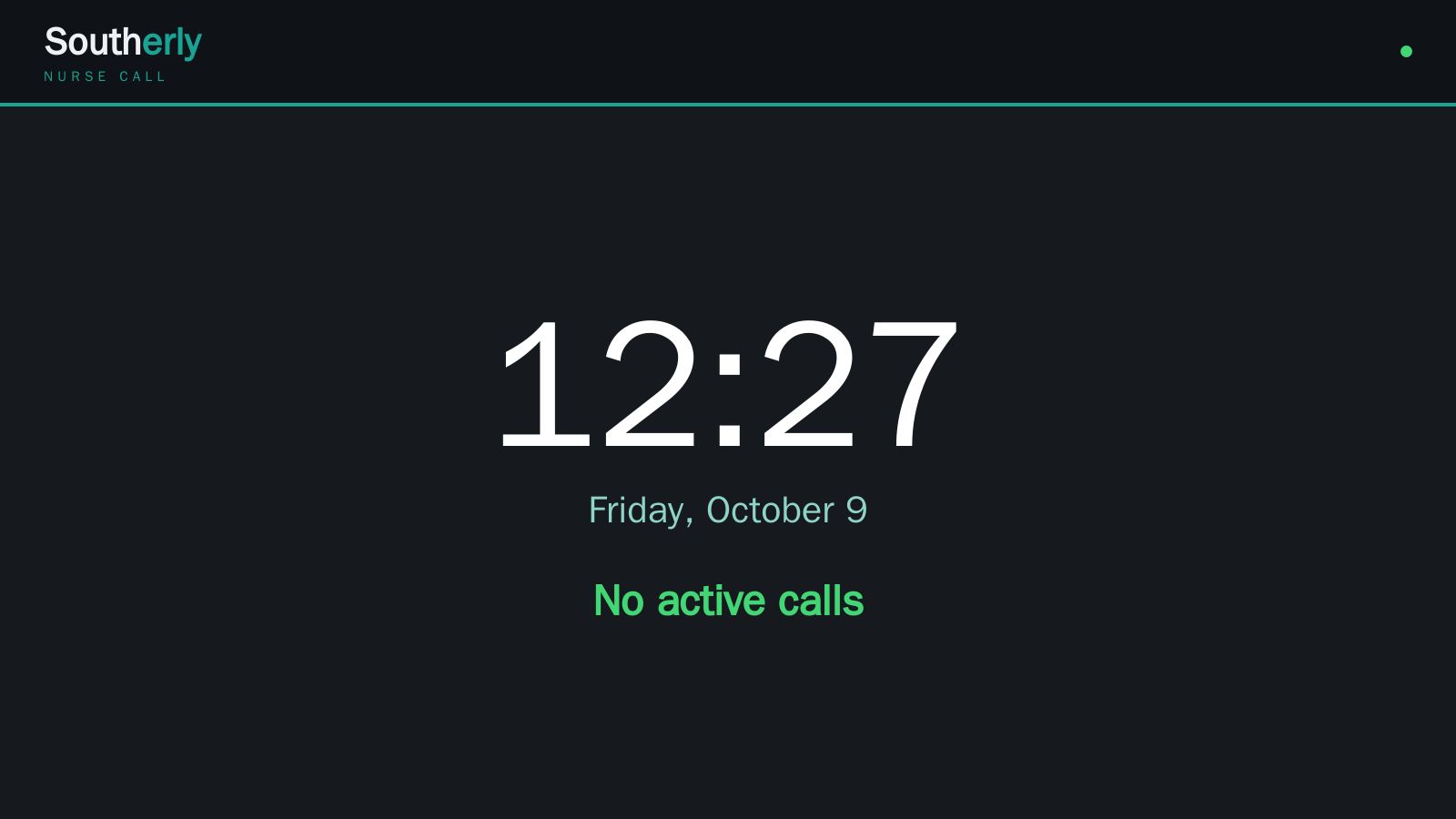
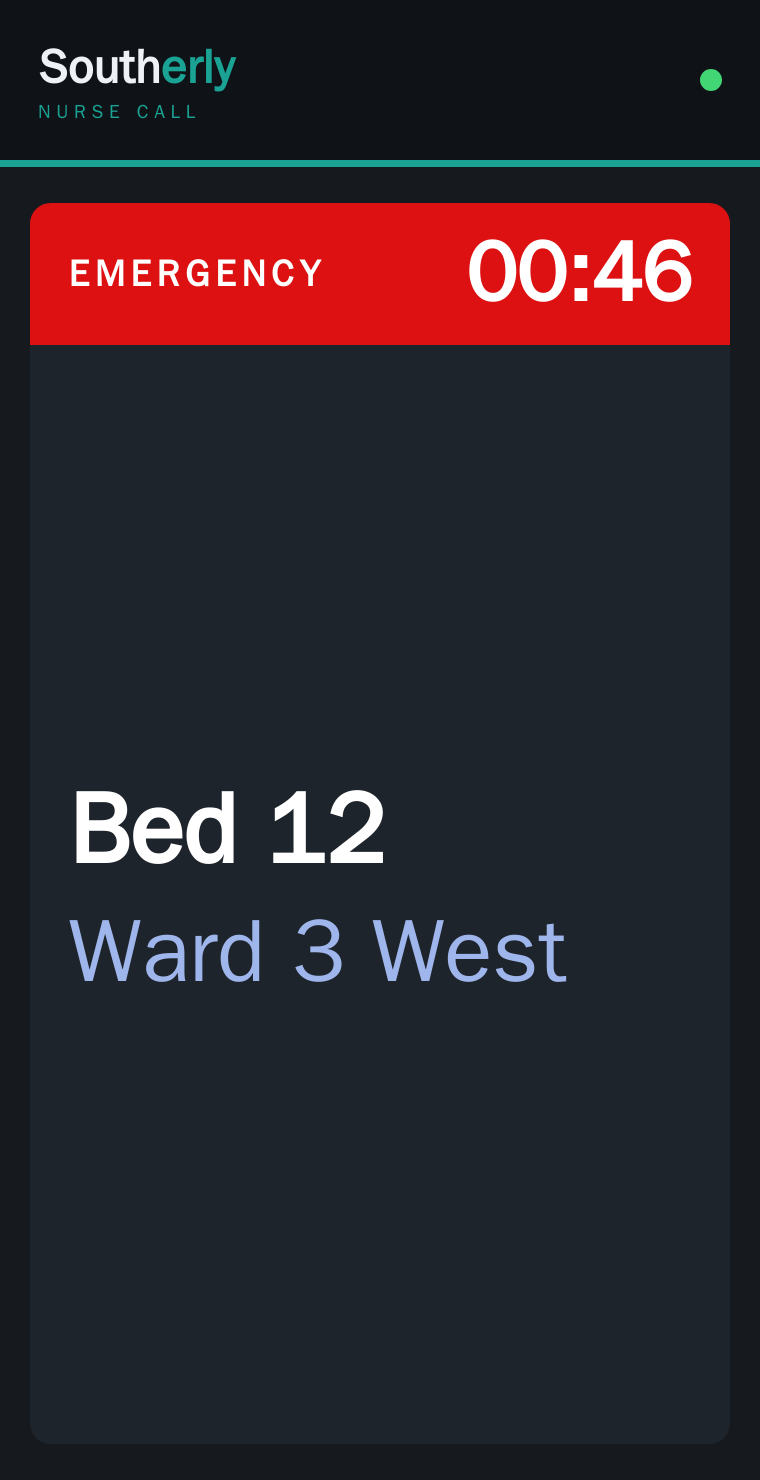
The node serves its own display — a full-screen Southerly call board — straight from the device over the ward LAN. Point a corridor TV, a staff-base monitor or a tablet at the node and it shows live calls, the call type and how long each has waited. No head end, no cloud, no app to install, and it keeps working if the gateway or the internet is down: the display is the node. Where a Ward Gateway is present, the same calls also feed the gateway's corridor and staff-base displays and its reports. Ward user guide → An out-of-band RS-485 backup link keeps the display fed even with the network down — it fails over automatically and back — with a LoRa link in development. See cyber resilience.
Resilient by design
The node runs on the ward LAN with no cloud and no internet, and the display runs on the node itself — so a failed switch, a ransomware outbreak or a severed internet link doesn't take a ward's calls or display offline. An out-of-band RS-485 backup link (available now) carries calls to the display when the network is down or under attack — the display fails over automatically and back — with a point-to-point LoRa link in development. Both paths are supervised, with a visible LINK LOST state if every path fails. How Southerly stays up in an outage or cyber attack →
Specifications
| Relay outputs | 8 × SPDT (NO/NC/COM), ≤10 A 250 V AC / 30 V DC — latched, momentary or timed pulse |
|---|---|
| Digital inputs | 8 × opto-isolated, dry contact or 5–36 V DC, supervised with debounce |
| Expansion | XM-02 PoE module, 8 out + 8 in, Ethernet primary + RS-485 backup, inputs raise calls like onboard — 1 per node now, 8 by design (72 / 72) |
| Buses | 1 × RS-485 (isolated, auto-direction) — doubles as the out-of-band display backup link · 1 × CAN |
| Network & power | 10/100 Ethernet; PoE 802.3af; or 7–36 V DC; DIN rail |
| Messaging | TAP/IXO to Olinqua, Ascom; MQTT (TLS) to Southerly displays and gateway |
| Display | Built-in web display server — self-hosted Southerly call board for a TV, monitor or tablet; runs with no gateway or cloud |
| Security | HTTPS (local CA), password login, signed firmware, OTA with rollback; security-reviewed Oct 2026 |
| Firmware | 1.4.0 |
| Status | Live |