The committee wrote a new standard, renamed it Hard-wired consumer communication and alarm systems for use in healthcare facilities, and extended it to cover residential aged care, mental health and disability settings alongside hospitals.
What stayed the same
The core principle survived intact, and it is worth stating first because the rest of the standard is built on it: calls for help must work when everything else has failed. The functions that summon a nurse — the call point, the corridor light, the annunciation — remain hard-wired. A cut network cable, a server fault or a power outage is not allowed to silence them.
If you have a well-maintained hard-wired system, that part of it is still the right foundation. Nothing in the 2026 edition asks you to replace working call points and loop wiring.
What changed
The 1998 standard described a system that lit a light when a button was pressed. The 2026 edition describes the system that actually runs a modern facility, and it formally recognises two layers:
- The hard-wired core, held to a very high availability expectation, segmented so that a single failure cannot take out more than one ward or wing, and backed by an uninterruptible power supply for at least 30 minutes.
- An ancillary layer of wireless devices, mobile notification, workflow, reporting and integration, which the standard now explicitly permits on top of the core. Pendants, wireless call points and staff phones move from a grey area into the standard proper.
On top of that structure, the new edition adds requirements that did not exist before.
Fault supervision
The system must detect its own failures, indicate them visually and audibly within 30 seconds, log them within five minutes, and deliver a verified alert to maintenance, escalating if nobody responds. "We'd notice if it stopped" is no longer an answer.
Cybersecurity
For the first time, security is treated as part of clinical safety. Multi-factor authentication, role-based access, least privilege, penetration testing and alignment with the ASD Essential Eight are expected of any networked part of the system.
Reporting
The system must aggregate its data and produce configurable reports, exportable to PDF and CSV. Response times, call volumes and staff presence become evidence rather than anecdote.
Location and presence
Room-level location, geofenced wandering alerts for residents at risk, and automatic recording of staff presence, including how long and how often staff attended, are now within scope.
Interoperability
Integration with mobile devices, electronic records and other building systems is expected, not exotic.
Does it apply to my existing system?
Australian Standards do not carry transition dates, so the honest answer has three parts.
- Nothing forces a retrofit. A system installed to the 1998 standard does not become unlawful because a new edition was published.
- But the 1998 standard no longer exists to be compliant with. Any new installation, extension or major upgrade will be specified against AS 3811:2026 from now on, and an existing system has no current standard to point to.
- The pressure arrives through accreditation and incidents. The Strengthened Aged Care Quality Standards ask providers to demonstrate that equipment is safe and fit for purpose, and assessors reach for the current benchmark. So do insurers and coroners. An existing system is measured against the 2026 ruler the next time something goes wrong, at reaccreditation, or when a refurbishment triggers the health facility guidelines that now reference the new edition.
Where most existing sites fall short
From the audits our installation company, Peninsula Smart Care, carries out across Victorian aged care and hospitals, the hard-wired core is rarely the problem. The gap is almost always in the management layer above it: the server or software that shows calls on screens, sends pages and produces reports.
Many of those platforms were written well before anyone expected a nurse call system to meet a cybersecurity standard. It is common to find them on unsupported operating systems, with no encryption between the browser and the server, shared or default passwords, no multi-factor authentication, and reporting that cannot be exported. Several run without any supervision of their own health, so a failed paging link or a stopped service goes unnoticed until a nurse reports a missed call.
There is a quieter gap in the core itself on some older loops: the call point is not supervised. A dead point or a broken line looks identical to "no call", so a failed point goes undetected. That fails the 2026 fault-detection clause head-on, and it is a life-safety gap rather than a paperwork one.
None of this is visible from the corridor. The lights still come on. It only shows up when an assessor asks for the fault log, the access log and the response-time report, and the facility cannot produce them.
What closing those gaps looks like on a ward
The standard's new requirements are easiest to judge when you can see them. This is the Southerly management layer running over a hard-wired loop: the same calls, now on the carer's phone, with every response recorded and every device supervised.
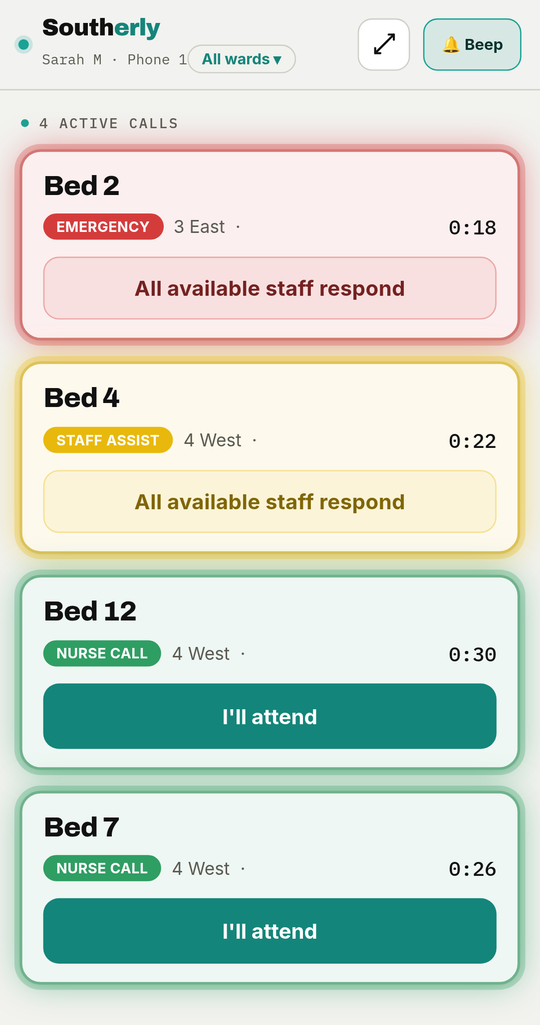
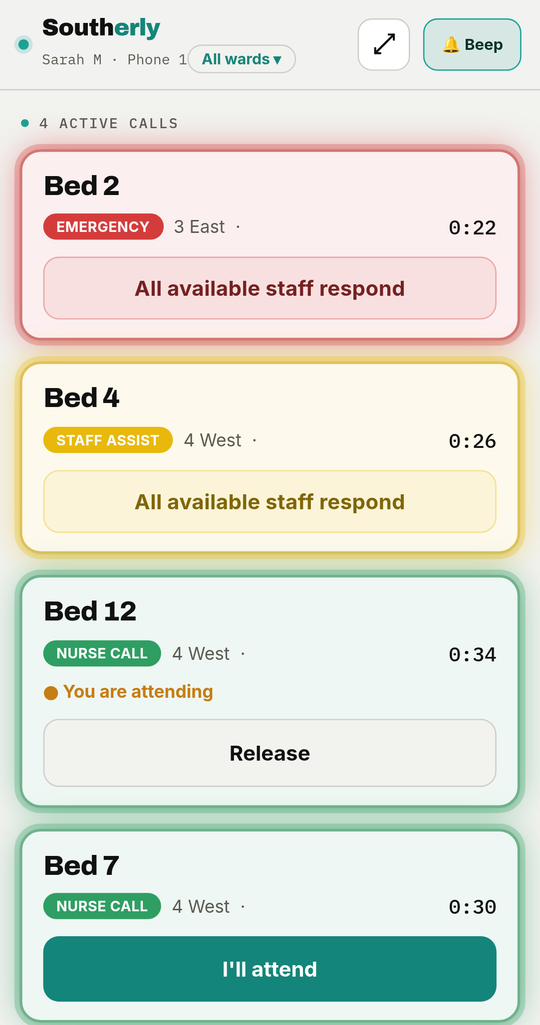
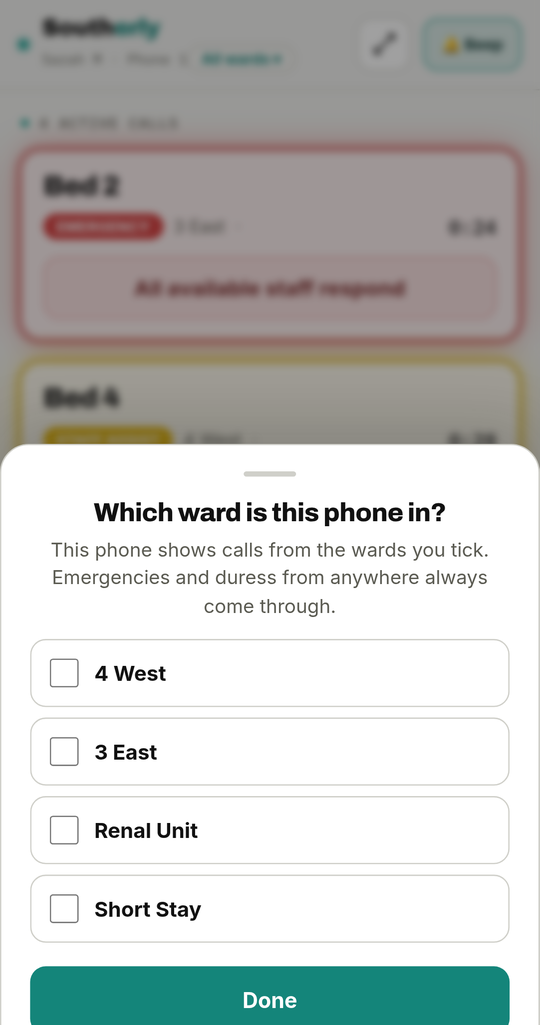
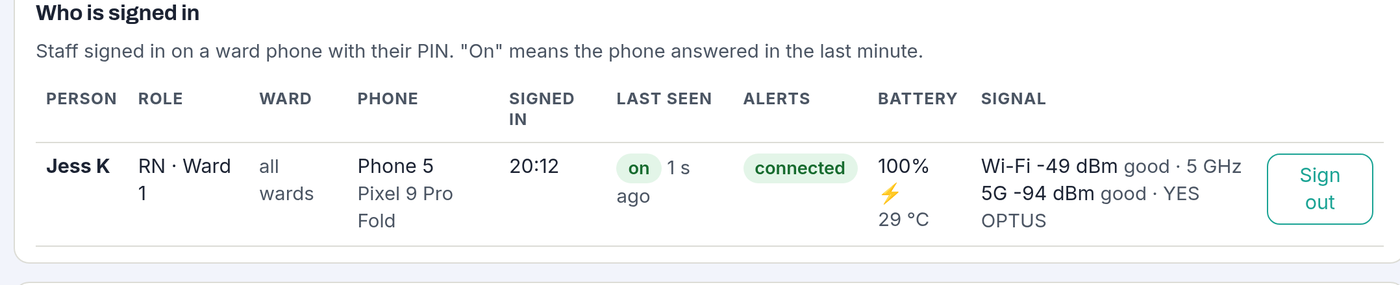
Screens shown with sample data. The staff phone app is in pilot with our first sites.
See it on your own ward
Book a 20-minute walkthrough. We will show the live board, the phone app and the fault, access and response-time records against your current system, and tell you plainly which AS 3811:2026 gaps it closes and which it does not.
A practical path
The two-layer structure of the new standard points to the sensible approach for most sites, and it is not a rip-and-replace weekend.
- Keep the hard-wired core if it is sound, and maintain it as before.
- Add the resilience the standard asks for: a UPS sized for at least 30 minutes, and where a site has several wings, segmentation so a single failure stays local.
- Put a compliant management layer on top. Fault supervision with maintenance escalation, encrypted access with multi-factor authentication, exportable reporting, mobile notification and presence detection can be delivered by the Enterprise Gateway sitting alongside the existing loop, without touching the call points.
- Replace unsupervised points ward by ward. A supervised call point such as CP-02 on a polled bus closes the fault-detection gap in the core, and the staged migration means no cutover weekend.
- Retire or fence off management software that cannot meet the security clauses, rather than leaving it exposed on the facility network.
- Document it. The evidence the standard expects is a fault log, an access log, a UPS test record and an exportable response-time report. Build the records before the assessor asks.
How Southerly measures up — honestly
Southerly Nurse Call is designed to AS 3811:2026. We do not say certified: conformance is assessed on the installed system, not on a product, and we would rather publish the list than hide behind a badge.
- Calls, lights and the ward display run on the ward LAN with no cloud dependency. Read how it behaves under attack → Live
- Proof of display. Every display confirms that it has drawn each call and each cancel. A display that does not confirm within seconds is raised as a fault, so a call left showing after it was answered, or a screen that has stopped updating, is caught by the system rather than reported by a nurse. Live
- Live calls are held through a gateway restart or software update; nothing on the ward screens is lost. Live
- Escalation engine, configurable reports with response-time percentiles and shift views, CSV export and print view, audit log, roles with per-user page access, directory login and lockout. Live
- Fault registry covering paging, messaging, displays and controller links, with supervised "no answer" states, a continuous self-test, remote health monitoring and a link-availability report for remote sites. Live
- TLS on the gateway's own interface, with an HTTPS-only setting; encryption at rest; nightly encrypted off-site backups. Live
- Supervised call points. The CP-02 point, and point supervision for an existing loop through our loop interface, which reports a dead or disconnected point without ever cancelling a call because of a wiring fault. The loop interface is working on the bench; neither is installed on a site yet. In development
- Staff phone app with a supervised alert link: the ward station shows, per phone, whether alerts can actually get through. In testing. In development
- Multi-factor authentication, true PDF export, maintenance escalation by SMS, and UPS and mains-fail supervision. In development
- Room-level location, geofenced wandering alerts and automatic staff presence (today presence is sign-in based). In development
When those items ship, this page changes. Until then the installer documents the compensating controls at commissioning, and you get that list in writing.
Questions we get asked
Do we have to replace our nurse call system because of AS 3811:2026?
No. The standard does not require existing systems to be replaced, and a sound hard-wired core is still the right foundation. What it requires of any new work, and what accreditors increasingly expect of existing sites, is fault supervision, cybersecurity, reporting and resilience in the layer above the core.
Is AS 3811:2026 law?
No. Like the 1998 edition it is a voluntary standard, but it becomes binding through specifications, accreditation expectations, health facility guidelines and duty of care. In practice it is the benchmark a system is judged against after an incident or at reaccreditation.
Our management server runs on an old operating system. Is that a compliance issue?
Under the 2026 edition, yes. Cybersecurity is now part of the standard, and an unsupported operating system with no encryption or multi-factor authentication does not meet it. The usual fix is a compliant management layer over the existing wiring rather than a new system.
How do we prove compliance to an assessor?
With records: a fault log showing faults were detected and actioned, an access log, evidence of the UPS and its testing, and response-time reports that can be exported. If the system cannot produce those, that is the gap to close first.
Is Southerly Nurse Call certified to AS 3811:2026?
It is designed to AS 3811:2026. Conformance is assessed on the installed system, not on a product, so no manufacturer can hand you a certificate for your site. We publish exactly which clauses our system meets today and which are still in development, and the installer documents the rest at commissioning.
Where can I get the standard?
From the Standards Australia store, as AS 3811:2026, Hard-wired consumer communication and alarm systems for use in healthcare facilities. Every facility manager responsible for a nurse call system should hold a copy.
Related
Enterprise Gateway
The management layer the standard now asks for: fault supervision, reporting with export, audit and access logs, over the wiring you already have.
Staged migration
Move to a supervised system ward by ward, with no cutover weekend.
Cyber resilience
How the system behaves when the network is down or under attack.
Confirmed delivery
Why every page to a phone or pager should be acknowledged, not assumed.